The GB nutrition and health claims register
Authorised claims are listed on the Great Britain nutrition and health claims (NHC) register. Each entry gives the nutrient, the exact claim wording and the conditions of use. Northern Ireland uses the EU register instead.
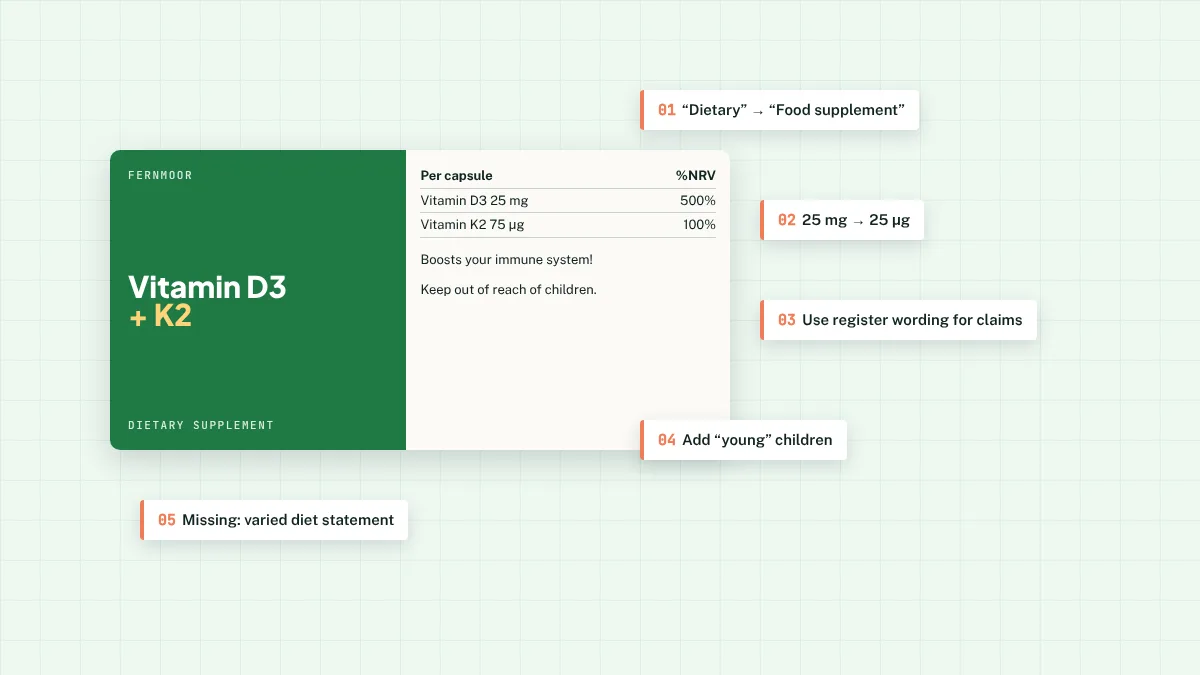
An example from the register: “Vitamin C contributes to the normal function of the immune system.” You can reword a claim slightly if it means exactly the same thing to a shopper, but you can’t make it stronger.
Conditions of use
Most vitamin and mineral claims need the product to supply a significant amount of the nutrient, which for supplements usually means at least 15% of the NRV in the daily dose. A label claiming vitamin C supports immunity needs at least 12 mg of vitamin C per daily dose (15% of the 80 mg NRV).
When you make a health claim, the label must also include:
- A statement on the importance of a varied and balanced diet and a healthy lifestyle.
- The amount and pattern of use needed to get the claimed effect.
- Where relevant, a statement for people who should avoid the product, and a warning if too much could be a health risk.
Wording that causes problems
| Avoid | Why | Try instead |
|---|---|---|
| “Boosts your immune system” | Stronger than the authorised wording | “Vitamin C contributes to the normal function of the immune system” |
| “Prevents colds” | A disease claim. Not allowed on food | Remove it |
| “Detox”, “cleanse” | Health claims with no authorisation | Describe the ingredients instead |
| “Good for your joints” | A general benefit with no specific claim next to it | Pair it with an authorised claim, such as one for vitamin C and collagen formation for normal cartilage function |
| “Clinically proven” | Implies a strength of evidence the claim doesn’t have | Use the authorised claim only |
General statements like “supports wellbeing” are only allowed when an authorised specific claim sits next to them.
Botanicals and “on hold” claims
Many claims for herbs and botanicals, such as ashwagandha or turmeric, were never assessed and are listed as “on hold”. Some brands still use them under transitional rules, but enforcement varies and the position can change. Get specific advice before you put an on-hold claim on a label.
When a claim makes it a medicine
If your label says the product treats, cures or prevents a condition, the MHRA can classify it as a medicine. That takes it out of food law altogether and it would need a licence to sell. Keep claims to the authorised food wording.
Not legal advice. This guide covers the general rules for food supplements sold in Great Britain. Check your own product with a regulatory adviser, your local Trading Standards team or your Primary Authority partner.