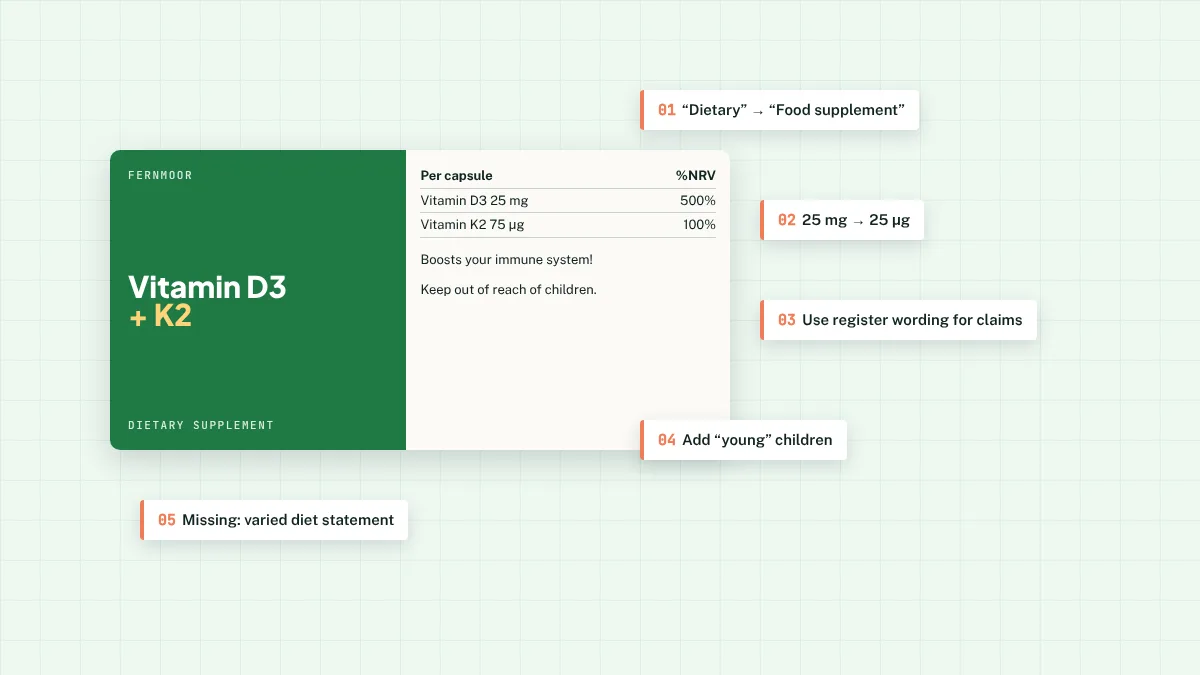
1. Calling it a “dietary supplement”
“Dietary supplement” is the US term. In the UK the product must be named a food supplement. We see this most on labels adapted from American templates or designed by overseas freelancers.
2. %NRV per capsule when the dose is two
The nutrient table must show amounts per daily dose. If the dose is two capsules, double the per-capsule figures. Getting this wrong halves every number on the label.
3. Using the compound weight, not the nutrient
500 mg of magnesium citrate is not 500 mg of magnesium; it is roughly 80 mg. Calcium carbonate is about 40% calcium. The table needs the nutrient figure. Our nutrient guides cover the common forms.
4. Mixing up µg and mg
Selenium, vitamin D, B12, folic acid, biotin, iodine and chromium are measured in micrograms. A label saying “Selenium 55 mg” claims a thousand times the real dose.
5. “Keep out of reach of children”
The regulations require a statement that the product should be stored out of the reach of young children. Dropping “young” changes the meaning, and inspectors notice.
6. Missing one of the supplement statements
Every label needs the daily dose, a do-not-exceed warning, the varied diet statement and the young children statement. We regularly see one missing, usually the varied diet line, when designers run out of space.
7. Giving %NRV for ingredients with no NRV
Only vitamins and minerals have NRVs. Omega-3, CoQ10, collagen and botanicals don’t. Show the amount and put a dash or “no NRV established” in the %NRV column.
8. Claims stronger than the register
“Boosts immunity”, “supercharges energy” and “clinically proven” all overstate authorised claims. Use the register wording. See how to check a claim.
9. Text below 1.2 mm x-height
Mandatory text must have an x-height of at least 1.2 mm (0.9 mm on packs whose largest surface is under 80 cm²). Designers often set the legal panel at 5 pt to make it fit. In most fonts that is too small.
10. Allergens not emphasised
Fish (in fish oil and marine collagen), milk (whey), soya (lecithin) and crustaceans (some glucosamine) must be emphasised in the ingredients list. See allergens on supplement labels.
11. No UK address, or the wrong one for NI
Products sold in Great Britain need a UK business name and address. Products sold in Northern Ireland need an NI or EU address. See selling in Northern Ireland.
12. Vitamin D in IU only
Vitamin D must be shown in µg. IU can be added alongside, for example “25 µg (1000 IU)”, but not on its own.
Want a second pair of eyes? Every quote we send includes a compliance check.
Not legal advice. This guide covers the general rules for food supplements sold in Great Britain. Check your own product with a regulatory adviser, your local Trading Standards team or your Primary Authority partner.